
HARVARD UNDERGROUND
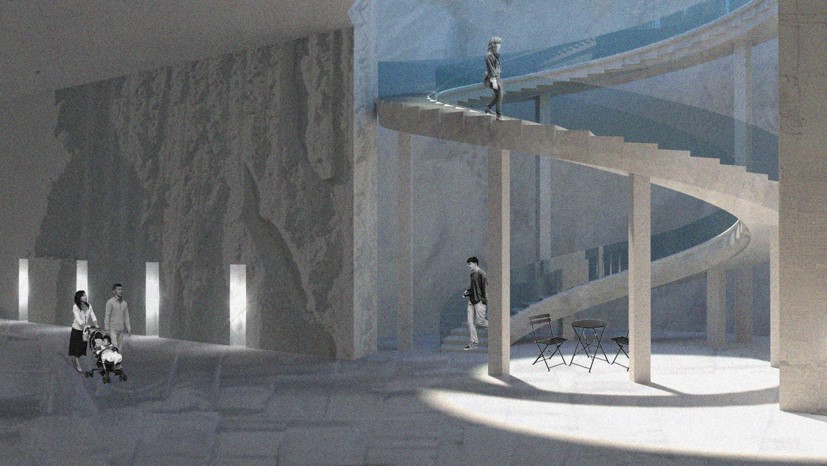
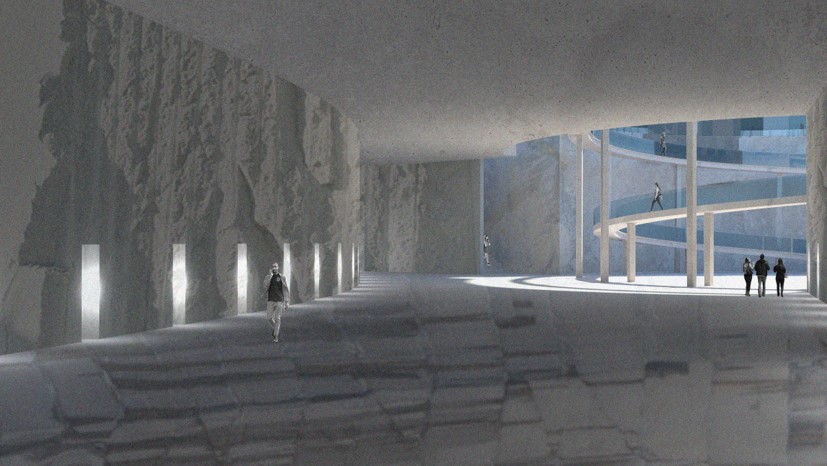
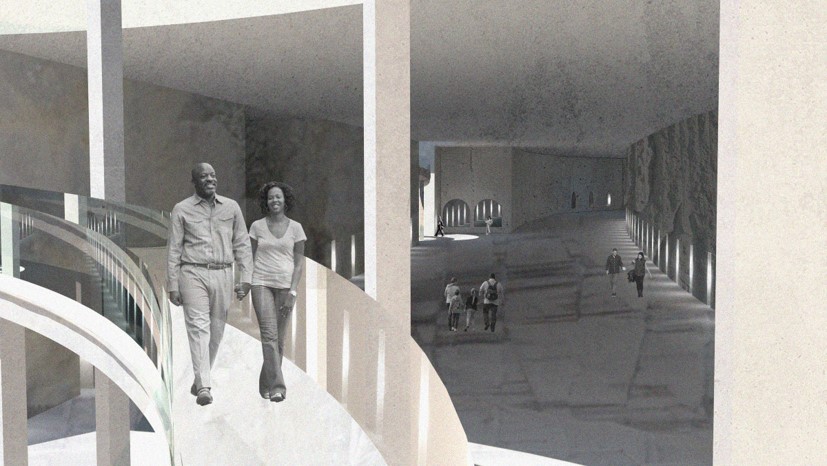
Brattle Tunnel, a decommissioned subway tunnel under Harvard Square is converted into a pedestrian thoroughfare. This intervention also serves as an opportunity to improve the infrastructure above ground, as well as reintroduce traditional vernacular building materials to the site. The thoroughfare allows pedestrians to circumvent the complex system of crosswalks and walkways above ground. The haptic experience in the tunnel is shaped by the portals acting as lightwells, entry points, and reflecting pools along the site. The tunnel becomes a quiet refuge from the bustling street above, where the public is invited to pass through or stop along certain points underground.
Institution
Harvard University Graduate School of Design
Project
Pedestrian Thoroughfare
Instructor
Jungyoon Kim
Date
Spring 2021
HARVARD SQUARE’S BRATTLE TUNNEL
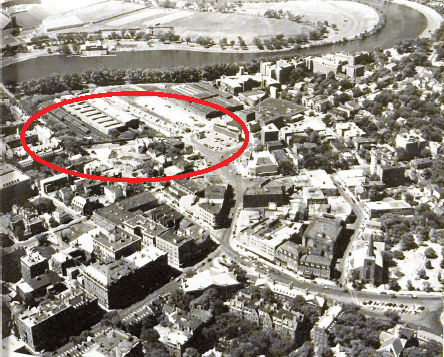
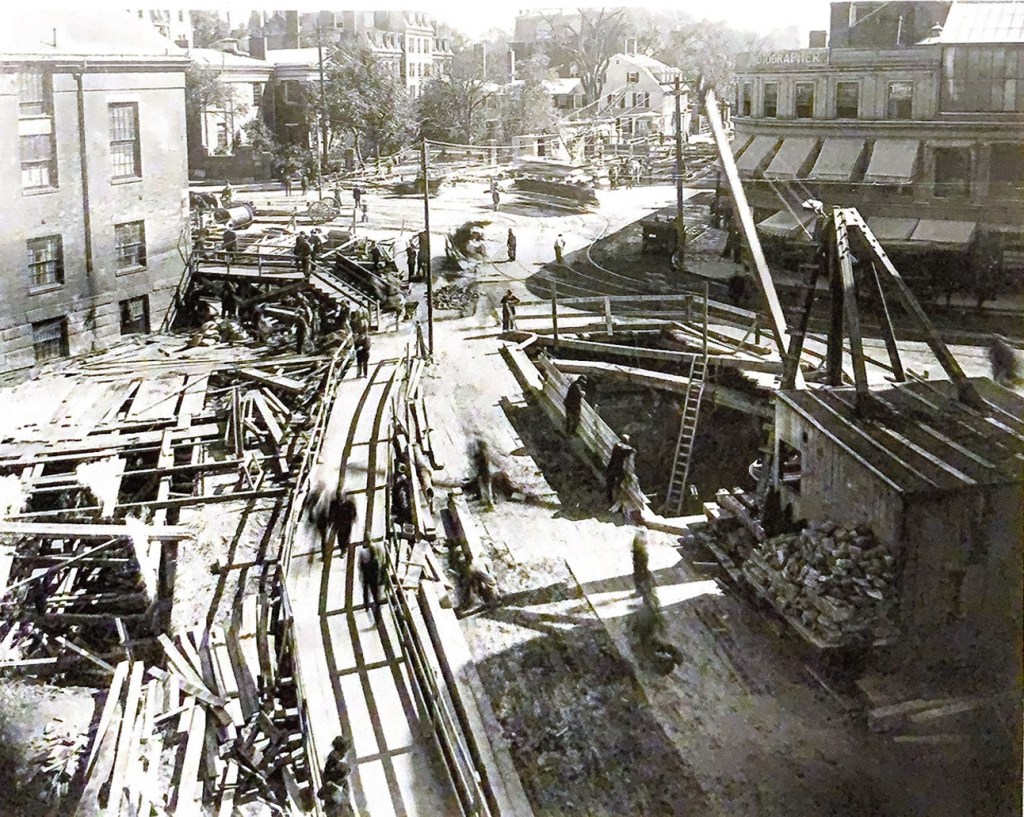
Left: Construction of Harvard Square Subway Station, circa 1910. Image courtesy of Jungyoon Kim.
Right: Aerial view looking toward the Charles River with the location of the former Eliot Square Shops and Bennet Yard highlighted, circa 1957. Image courtesy of Jungyoon Kim.
Brattle Tunnel is located under Brattle and Eliot Streets in Harvard Square and was completed in 1912. Defunct since the 1960s, the tunnel was originally designed as a three-track tunnel that ran to the Eliot Square Shops and Bennet Yard, a train depot with repair shops and a track where outbound trains could reverse direction. The Eliot Square Shops and Bennet Yard are now the site of the Harvard Kennedy School and the John F. Kennedy Memorial Park. Brattle Tunnel is 15 feet high and ranges in width from 36-feet wide to 60-feet wide. The portion of the tunnel under Eliot Street has restricted access and the other side directly under Brattle Street currently functions as a bus tunnel and platform.

Steel hatch entryway to Brattle Tunnel, located on Eliot Street. Images courtesy of Jungyoon Kim.
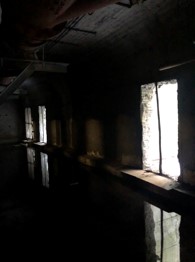
Current state of the defunct portion of Brattle Tunnel. Image courtesy of Jungyoon Kim.
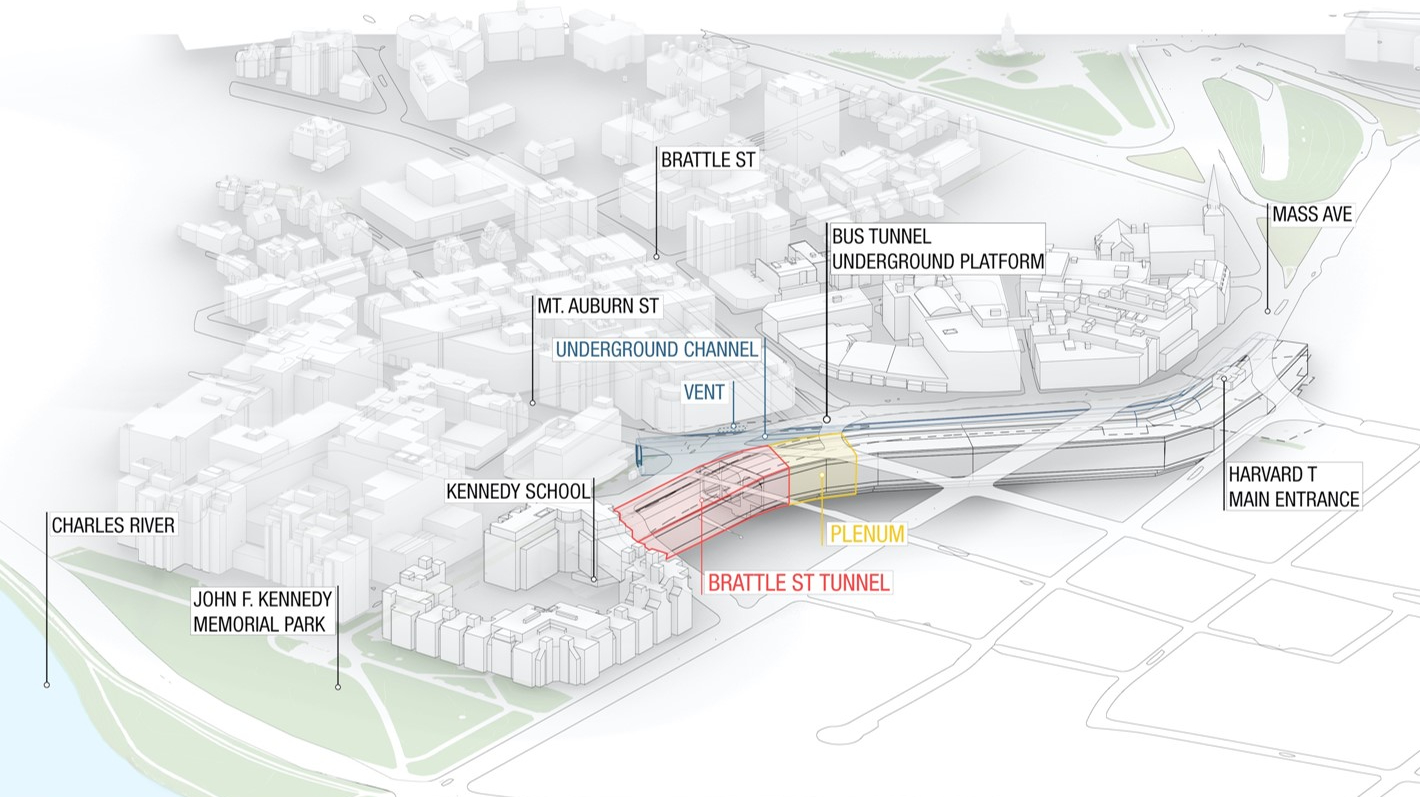
Drawing courtesy of Jungyoon Kim and Kari Roynesdal
FOUR PORTALS TO BRATTLE TUNNEL

- Streets Above and Surrounding Brattle Tunnel
- Crosswalks in Relation to Streets Above and Surrounding Brattle Tunnel
- Areas of Possible Intervention to Ameliorate the Pedestrian Experience in Harvard Square
- Intersection of Pedestrian Interventions and Brattle Tunnel
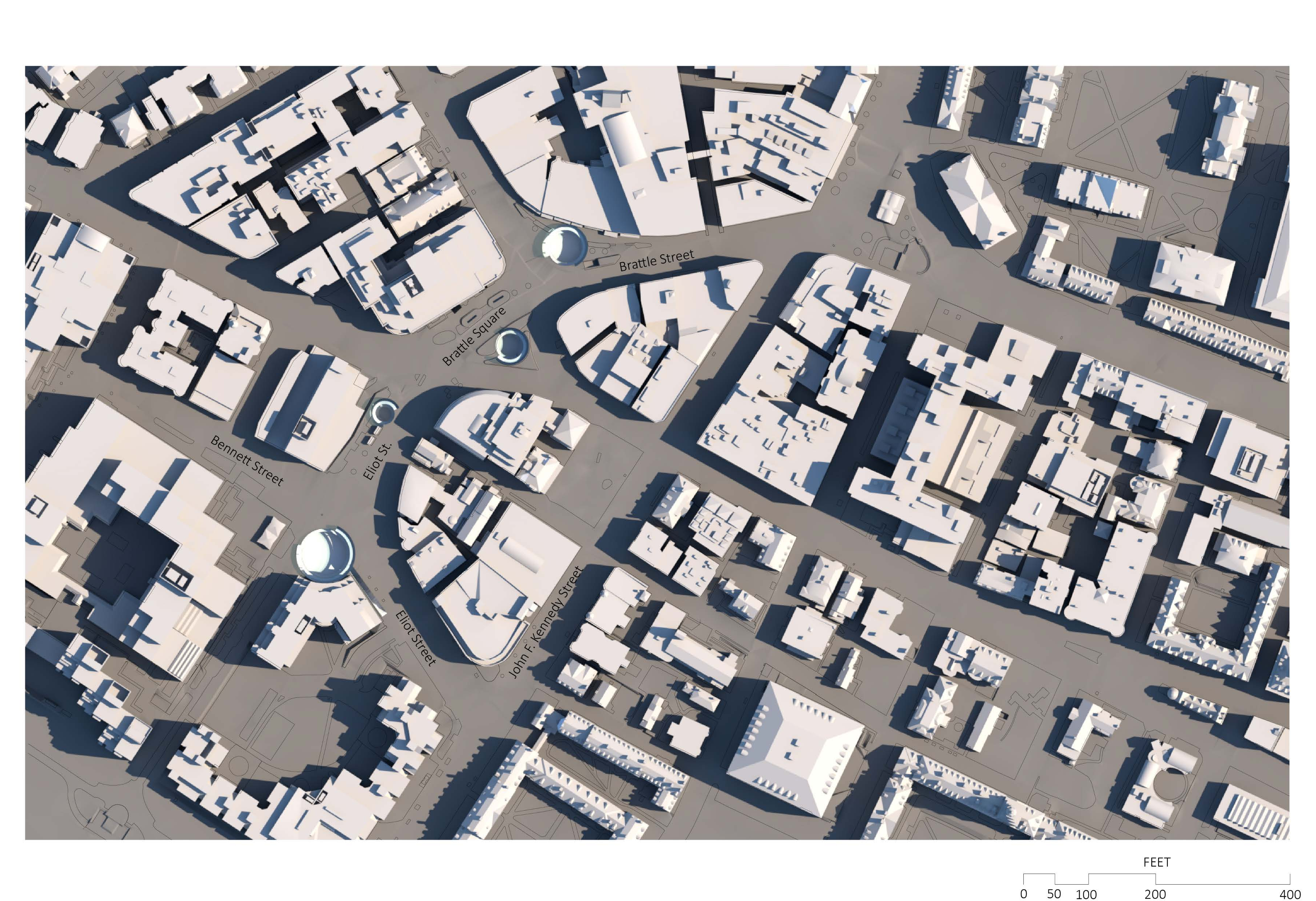
Harvard Square and its surrounding areas are characterized by being an equally important thoroughfare for automobile and pedestrian traffic. The connection from Brattle Square to Eliot Street into John F. Kennedy Street, which is a direct link into Boston, makes this an extremely popular route for vehicles. Pedestrians navigate this major vehicular thoroughfare through a series of maze-like crosswalks. By studying the pedestrian and automobile traffic, four areas were identified where interventions could be made to better negotiate this relationship. After identifying these above ground conditions, a strategy was developed to determine how these interventions could be incorporated into Brattle Tunnel to create an underground pedestrian thoroughfare.
Left: Proposed Portals to Brattle Tunnel
PORTALS TO THE UNDERGROUND HISTORY OF HARVARD SQUARE

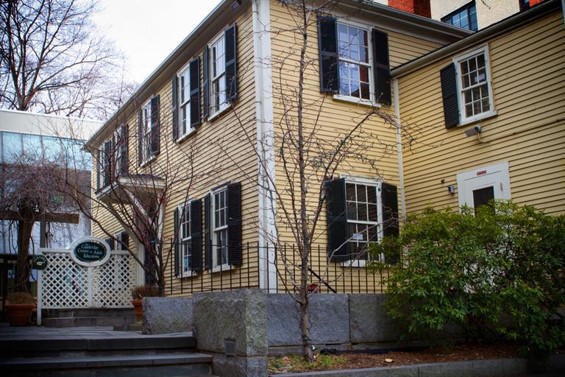
Left: Longfellow House, 105 Brattle Street, once occupied by George Washington and several of his slaves. Courtesy of SAH Archipedia.
Right: 56 Brattle Street, former home of Mary Walker, a woman who escaped slavery. Courtesy of WBUR News.
Beyond serving as pedestrian paths, the portals shed light on aspects of the underground history of Harvard Square. Brattle Street is named for William Brattle, who was a minister at the First Church of Cambridge and owned at least one slave. The historic Vassall-Craigie-Longfellow House is located at 105 Brattle Street, which was once occupied by George Washington and several of his slaves. The home was built by John Vassall, who made his fortune through sugar plantations in Jamaica. Vassall kept a number of slaves in his Cambridge home. Brattle Street is also the site of the home of Mary Walker, a woman born into slavery in 1818, who escaped from bondage and lived at her residence at 56 Brattle Street for 42 years.

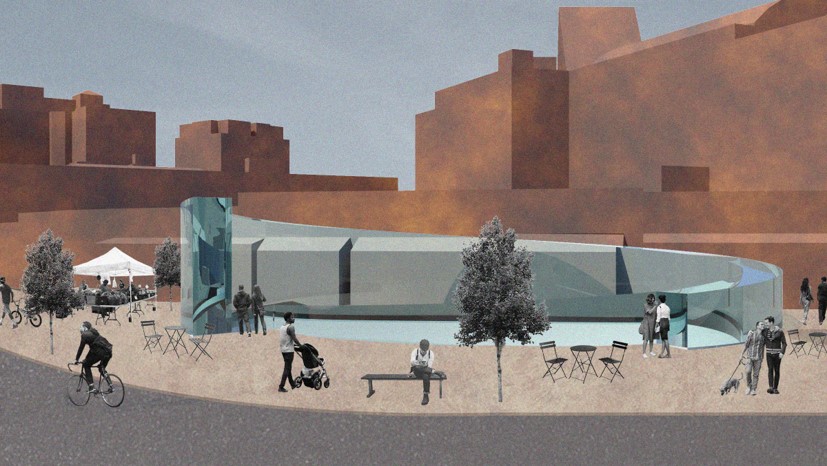
The portal at the intersection of Brattle Street and Brattle Square serves as a memorial in honor of the lives of slaves, known and unknown, that contributed to the growth of Harvard Square. The portal located at the intersection of Bennett Street and Eliot Street becomes an opportunity to acknowledge the Indigenous peoples on whose land we reside. This memorial acknowledges that the site is on the traditional and ancestral homelands of the Massachusett, Nipmuck, and Wampanoag Nations, many of whom were displaced by colonialist settlements. The two remaining portals are solely pedestrian entrances.
Bottom Left: Memorial to the legacy of slavery in Harvard Square located at the intersection of Brattle Street and Brattle Square.
Bottom Right: Portal serving as an Indigenous land acknowledgment of the Massachusett, Nipmuck, and Wampanoag Nations.

GRANITE AND WATER
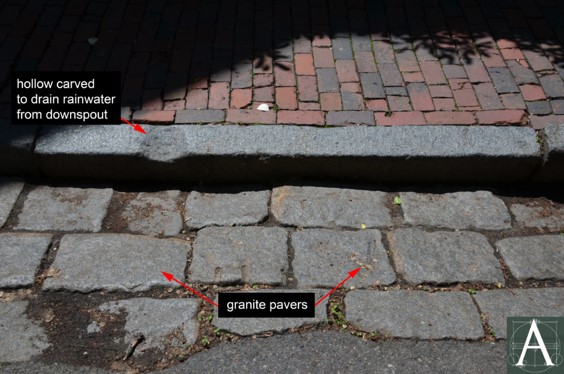

Left: Gutter at the west side of Louisburg Square, Boston, Massachusetts, showing large setts (ca. 1835-45) with hammered granite curbing and brick sidewalk. Courtesy of Archipedia New England.
Right: Granite seawall in Gloucester, Massachusetts Lanes Cove. Courtesy of the Boston Globe.
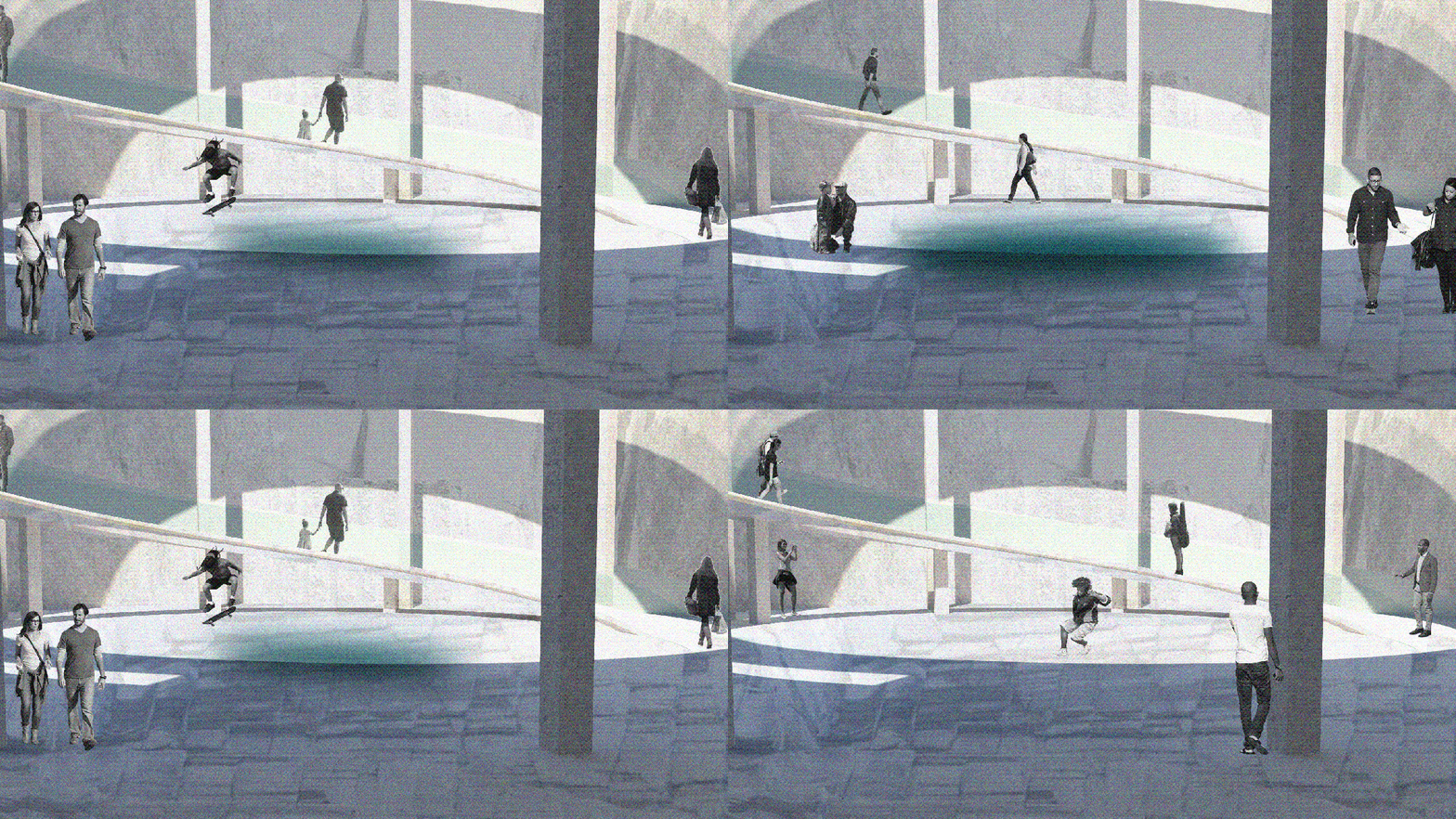
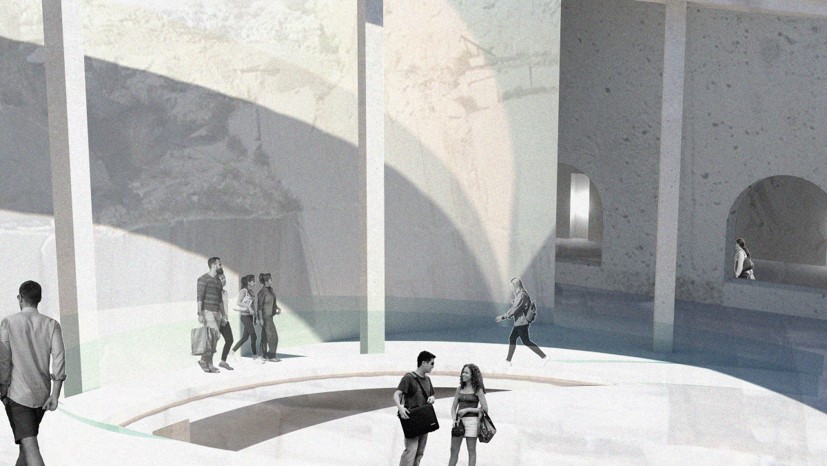
Each portal’s subterranean plaza has a slight slope towards its center such that when it rains, the water pools in the middle. This creates a natural water feature that forms a corresponding shift in activity near its boundary. Due to the granite’s ability to deform, overtime the shape of this water feature will transform with the different weather it experiences.
REFLECTING POOLS


Top: Aerial view of vents providing water and light to plenum in Brattle Tunnel.
Left: Vent above plenum in Brattle Tunnel.,
Right: Water channel in plenum of Brattle Tunnel.
Images courtesy of Chelsea Kashan, Edda Steingrimsdottir, and Yuki Takata
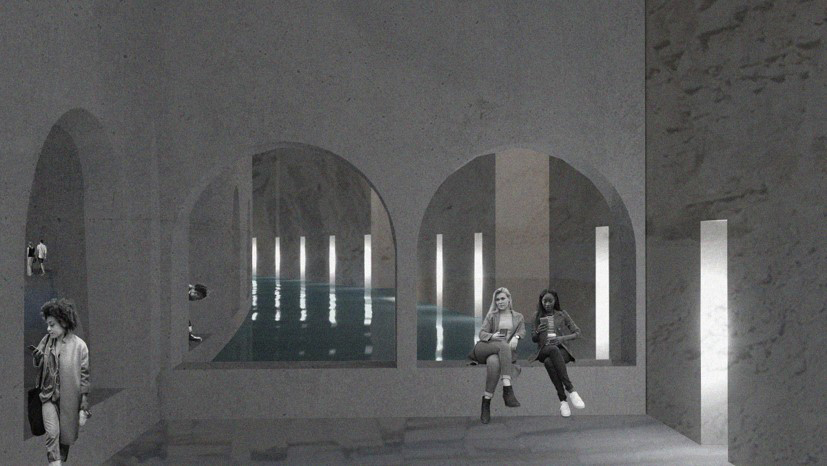
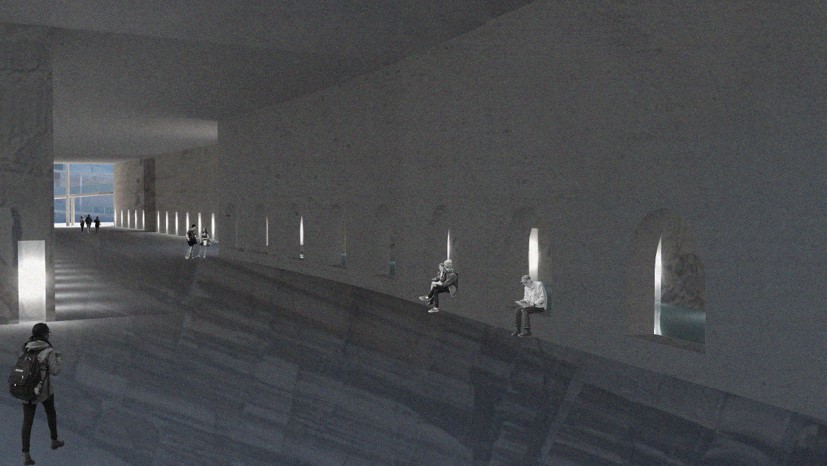
Located in the plenum of the tunnel is a water channel that is sourced with water from two large vents near Brattle Square. This channel is already set up with drainage so that it’s not stagnant, and the vents bring light and fresh air into the tunnel. The project explores the potential of this detail as a reflecting pool, where its water levels are a direct response to the weather conditions above. There is currently a large wall of arches that separates this channel from an MBTA storage room. By converting the existing archways along this waterway into benches, pedestrians will be invited to sit along the edge of the channel. The experience in the tunnel is shaped by the relationship between the stone, existing concrete, and the water features within it. The project heavily relies on the haptic relationship between the sound of the water echoing off of the granite and the concrete material.

RAMPS AND STAIRS TO BRATTLE TUNNEL
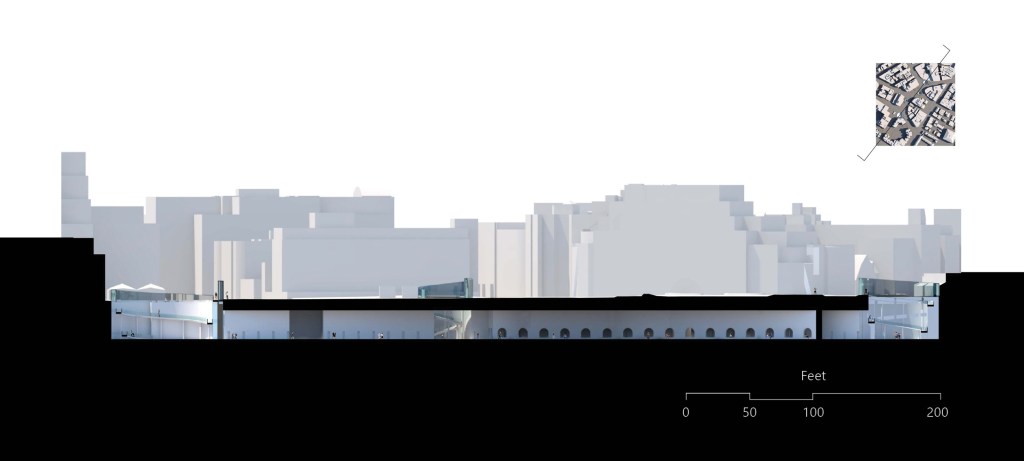
LONGITUDINAL SECTION
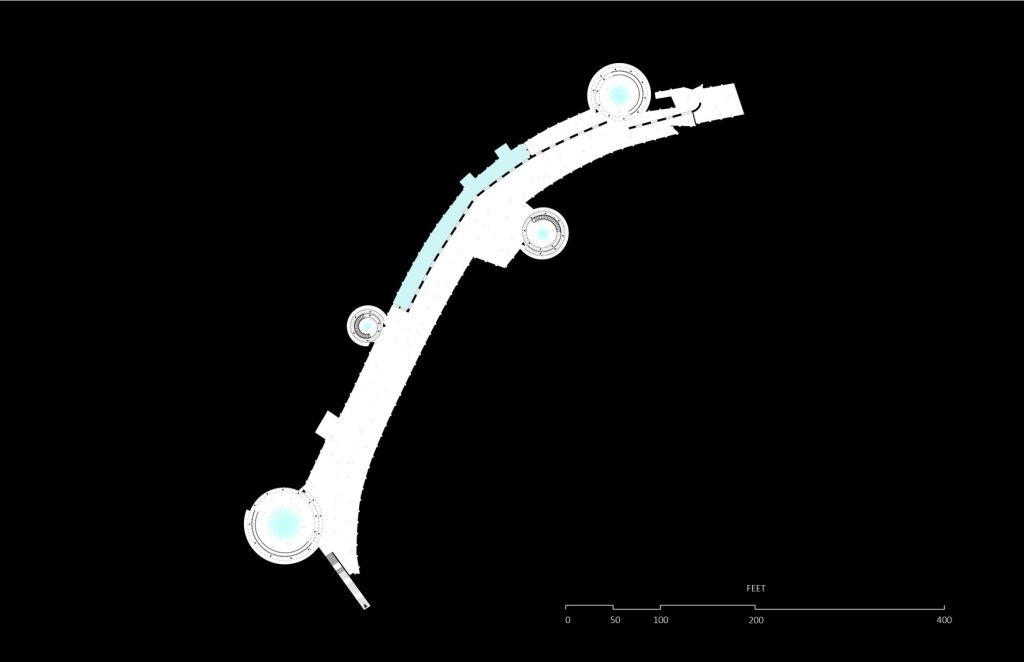
The new thoroughfare allows pedestrians to move from the Kennedy School to the intersection of Brattle Street and Brattle Square, while remaining completely underground.

Left to Right: Section AA, Section BB, Section CC, Section DD
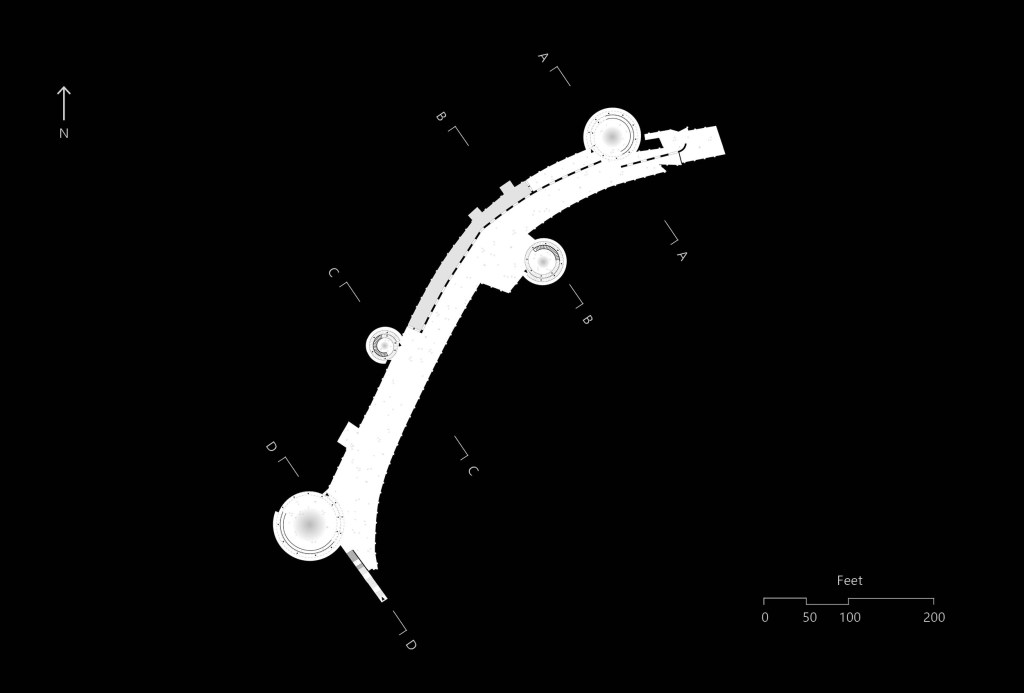
AA
An accessible entrance located at the intersection of Brattle Street and Brattle Square.
BB
A set of stairs is now located in Brattle Square, where there was formerly a small plaza.
CC
A large, empty sidewalk corner has been transformed to a portal with stairs that lead to Brattle Tunnel.
DD
An accessible ramp is paired with the
previously closed-off entrance to Brattle Tunnel on Eliot Street to provide multiple modes of entry to the thoroughfare.
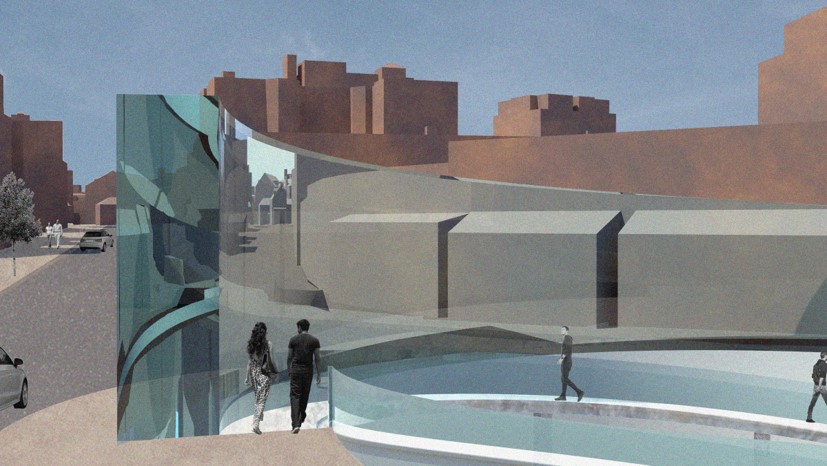
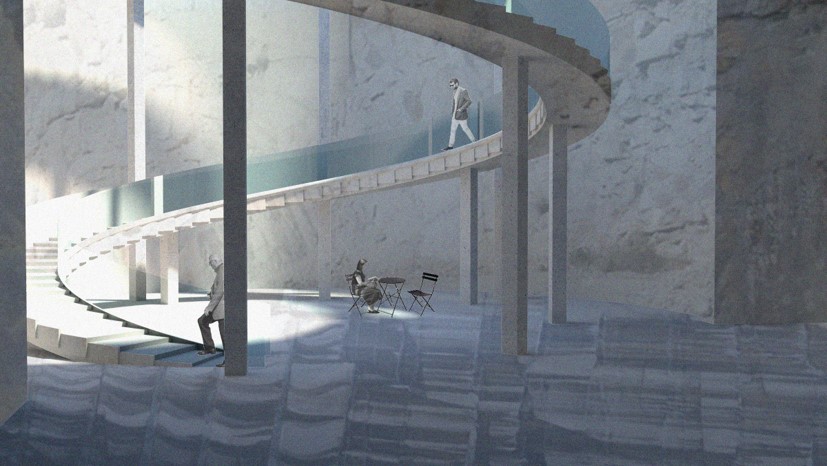
The intervention takes the form of four large circular portals that bring people and light down into the tunnel. The tunnel acts as the connector between these portals, allowing pedestrians to move from the intersection of Brattle Street and Brattle Square to the Kennedy School at the corner of Bennett Street and Eliot Street while remaining completely underground. The entrance to each portal is marked with a large glass structure that signifies an entrance to this thoroughfare from a distance. The glass structures also bring additional light into the tunnel. Each portal uses a spiral ramp or staircase to bring pedestrians below ground so they can circumvent the automobile traffic above.
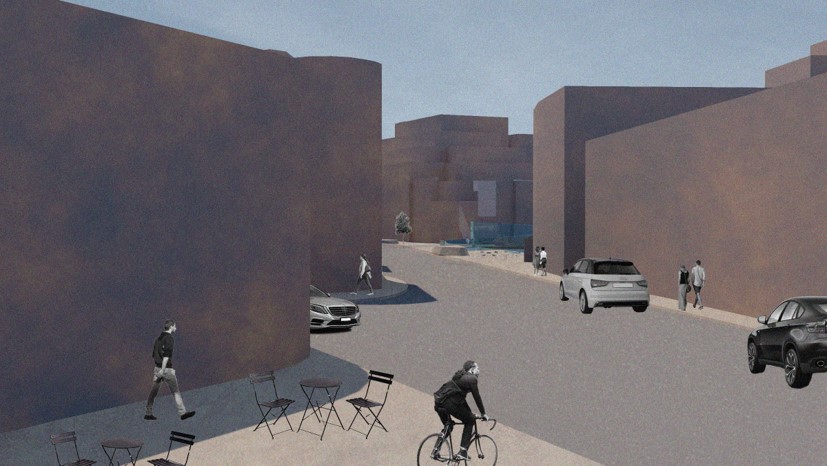
ABOVE AND BELOW: A NEW PEDESTRIAN EXPERIENCE
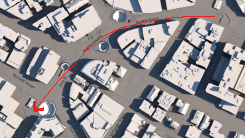
Walking path beginning from Brattle Street and ending at the intersection of Bennett Street and Eliot Street.





 Tara Oluwafemi