
PLAY BALL

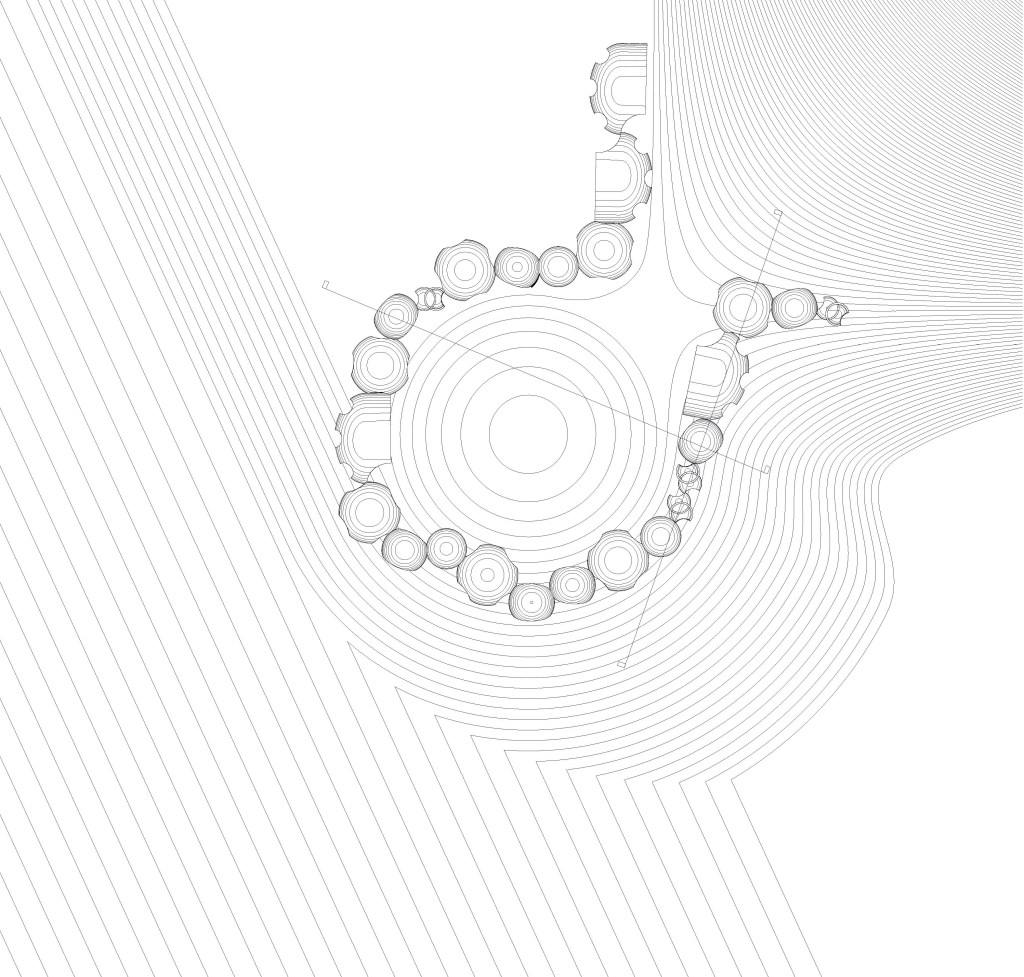
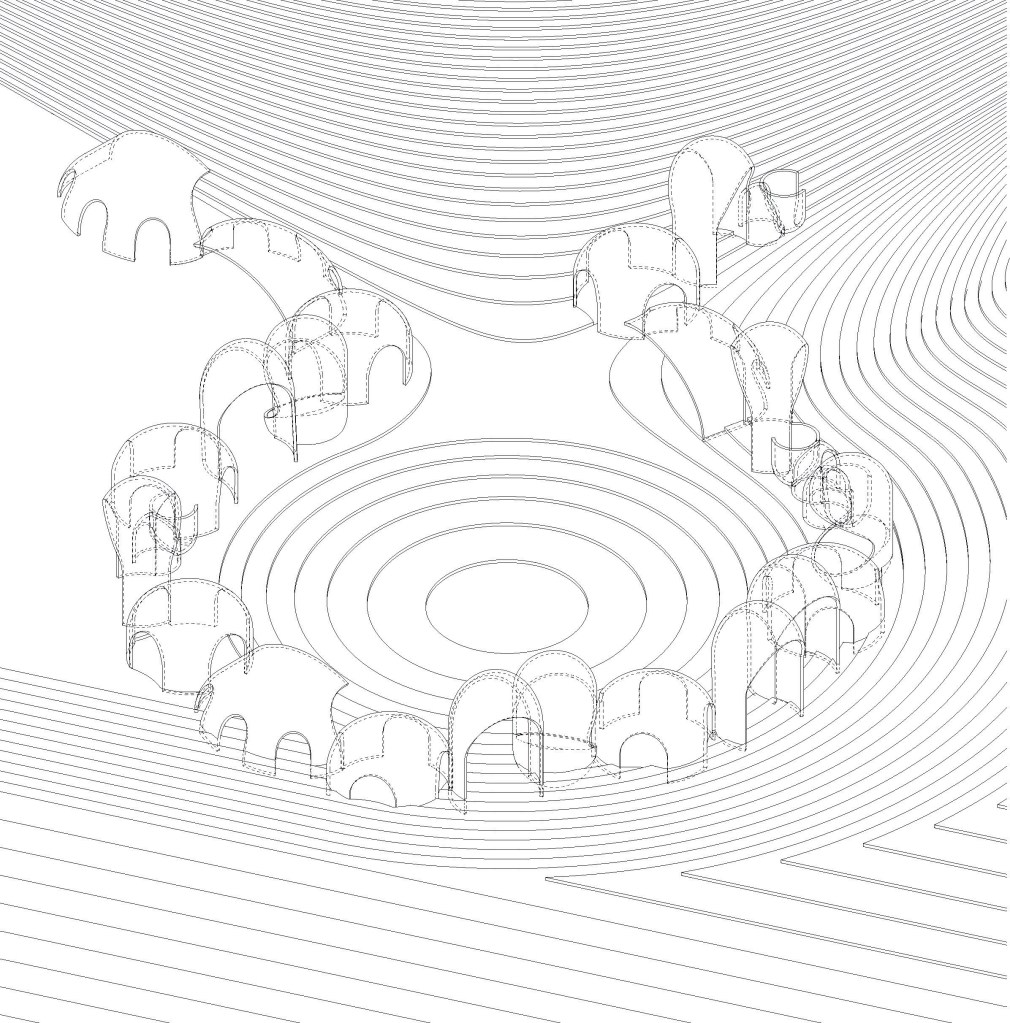
Primary to the identity of the project is the continuous curve evident in plan, section, and elevation. Preserving this curve required careful consideration of consistent wall thicknesses, the connections between spatial bays, and unity with the topographical contours. Essential to the underlying organization was a system of circles tangent to the contours of the topography. The structural objective of the link of bays was to create a permeable fence that could also be inhabited. The fence was further activated as a receptacle and return system for balls. The bays created a boundary denoting an interior field, while simultaneously creating spectator seating and an athletic complex covering ranging intensities of activity. The skill level required for each activity is determined by the location of their associated bays on the topography.
Institution
Harvard University Graduate School of Design
Project
Interconnected Spatial Bays
Instructors
Megan Panzano
Date
Spring 2019
TETHERBALL AND TANGENTIAL BAYS

The structural bays of the activated boundary stem from the cylindrical and domed forms created by the swinging motion of a tetherball. The string in the game of tetherball keeps the ball from escaping the area of play. By building on this principal, five spatial bays are developed, where the architecture of the bays return the balls to the field through curved edges promoting circular motion.
Left: Axonometric and plan view of the range of motion of a tetherball.
Each bay varies in scale to accommodate balls of varying size and game play at different skill-levels. Several bays also function as shaded areas for spectators. There are openings at the scale of humans to encourage small regions of play within the larger field. Every bay possesses an element of the DNA of the motion of the ball in tetherball: a half-dome, a dome, a cylinder, or a combination of these forms.
Right: Five spatial bays based on the cylindrical and domed motion of a tetherball in play.

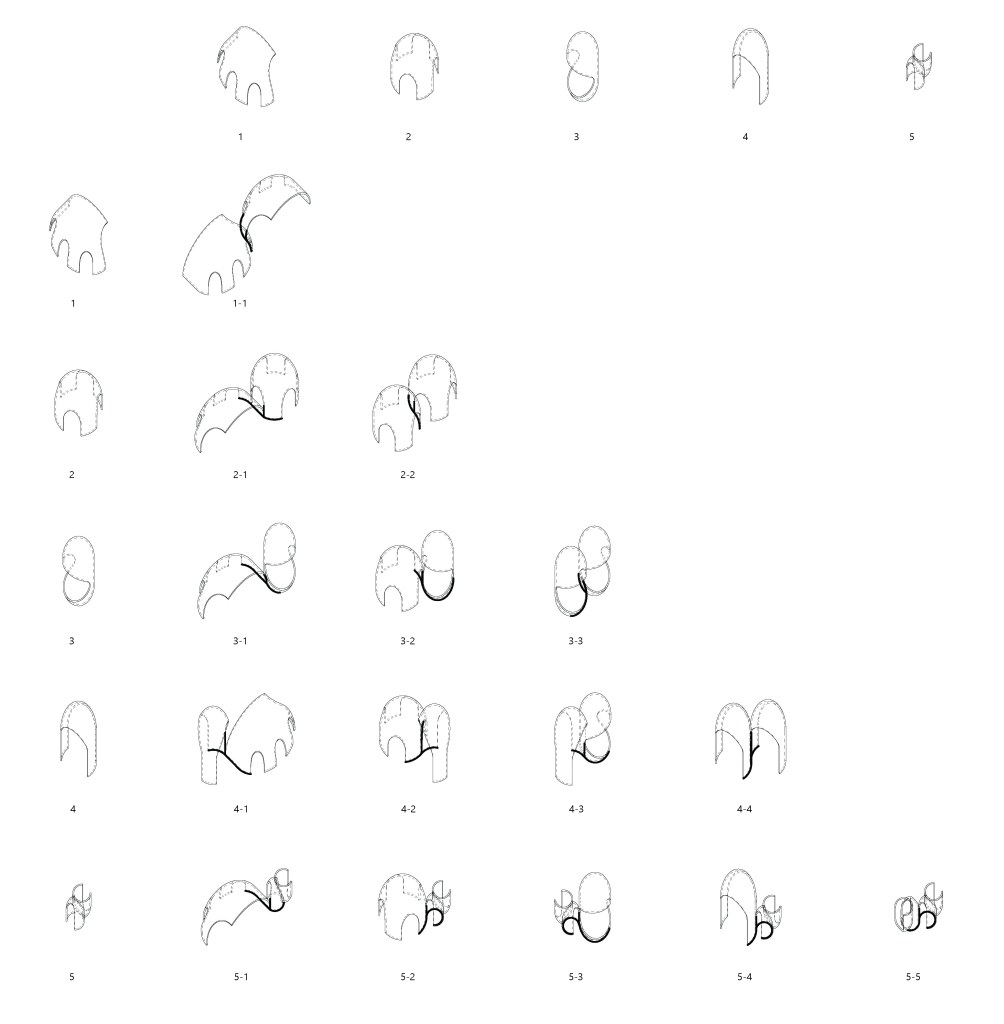
A system of bay pairs was created based on the tangential relationship between their bases to determine how the bays should be connected along the site. By connecting each bay tangentially, any ball that would roll up against the bases would follow the curve of the fence and return to the field of play.
Each bay is situated along the site such that it responds to the contours of the terrain. Interconnected spatial bays work together to respond to the shifting landscape. Bays located on stepped regions of the site promote more rigorous game play than those on flat areas. The spatial bays become a responsive fence that is designed to be in conversation with the landscape, and also become active participants in any games played within their bounds.

 Tara Oluwafemi